Discussing Latin America in class always reminds me that food and culture are always part of the areas history. In the Chasteen Reader, Chapter 3, we read about how European colonization and the rise of plantation economies depended heavily on forced labor systems, including slavery and debt peonage. This context makes me look at Costa Rica differently. Behind the rich culture surrounding food, the beauty of its coffee farms, and banana plantations lies a longer story about labor and inequality that shaped much of Latin America. The same kinds of systems that Chasteen described across the Caribbean and Central America also touched Costa Rica, especially during the rise of banana companies in the early 20th century, when imported laborers worked under harsh conditions for foreign corporations.
Costa Rican cuisine has deep roots that go back to the indigenous peoples, who relied on corn, beans, squash, cacao, and tropical fruits. When the Spanish arrived in the 1500s, they brought new ingredients like rice, pork, beef, dairy, and spices, which blended with native foods to create the foundation of today’s traditional dishes. Later, African and Caribbean influences along the coast added flavors like coconut, yuca, and plantains, making Costa Rican food a mix of many latin cultures. What’s special about the cuisine is how fresh and local everything is, with tropical fruits, seafood, and vegetables playing a huge role in everyday meals. Reading Fernando Ortiz’s Cuban Counterpoint helped me think about this more critically. Ortiz writes about “transculturation,” the idea that cultures in the Americas didn’t just blend peacefully but that they collided and transformed each other through unequal power and forced labor. The same process happened with food. The African and Indigenous ingredients that define Costa Rican cuisine today came through pain and forced labor. Bananas, sugar, and coffee, products that we now see as national symbols, originated from systems that exploited African and Indigenous workers, as Ortiz describes when comparing sugar’s “crushing labor” to the grinding of the cane itself Thinking about this, I realize that the foods I love most are connected to deep histories of both resilience and suffering.
This is a Banana and palm oil plantation that I drive by often.
In Quepos, banana farms harvest, wash, and pack bunches before shipping them abroad. Palm oil plantations press palm fruit into oil that’s refined and exported for use in foods and cosmetics. Both industries keep Costa Rica closely tied to global trade.

Coffee and fruit, especially bananas, play a huge role in Costa Rica’s culture and history. Coffee was once the country’s biggest export and helped shape its economy, while bananas became a major crop in the early 1900s, especially around areas like Quepos. Now, these products are vital to the economy and a part of daily life, with fresh coffee and tropical fruits enjoyed at nearly every meal.
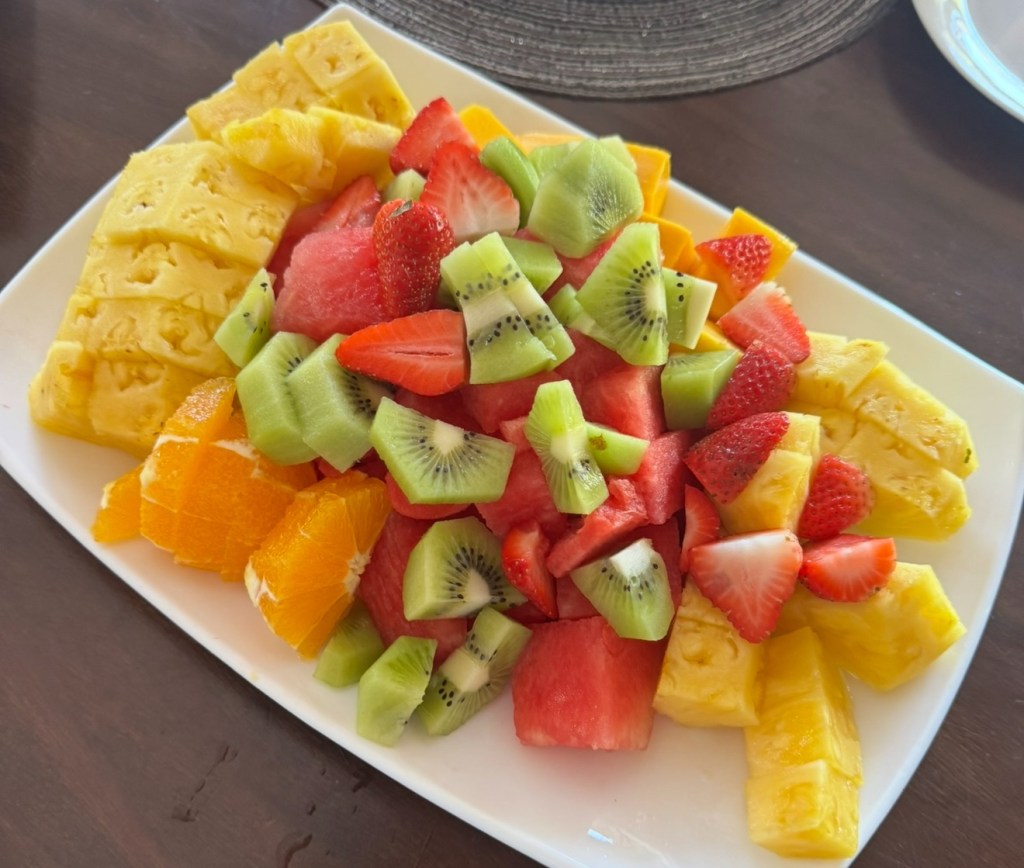
Fresh, and imported fruit from the supermarket.
My favorite foods will always be breakfast, specifically gallo pinto, Costa Rica’s most iconic breakfast. It’s a simple mix of rice and beans, but it’s so delicious, especially when paired with eggs and fresh cheese. When I am in Costa Rica, I eat gallo pinto for breakfast, lunch, and dinner often– I cannot stay away from it.

Breakfast from my favorite breakfast place in town, Emilio’s Cafe. This is a mix of eggs, fish cheese, Gallo pinto, plantains, and fresh fruit.
For lunch or dinner, the absolute best is the Costa Rican staple food of Casados. Personally, I like casado con pollo, “Casados” means “married” because it brings everything together on one plate—rice, beans, chicken, salad, and fried plantains. I love how satisfying it is and how it represents balance and togetherness, which are so important in Costa Rican culture. Still, after studying the readings and our discussions in class, I’ve started to think about how the idea of “balance” and “togetherness” in food contrasts with the historical imbalance in labor that produced it. The harmony I see in a plate of casado was built on generations of uneven work, the “hidden costs” of export economies. Ortiz’s notion of transculturation reminds me that cultural blending often came through survival, not choice. The food tells both stories at once: joy and hardship, unity and division.
Another favorite of mine is patacones. They’re sliced, fried, flattened, and fried again until perfectly crispy. I usually eat them with black beans or guacamole, and they’re the best snack to eat at the beach. Patacones trace back to African and Caribbean influences and show how different cultures have shaped Costa Rican cooking.

Me enjoying a patacon with guacamole, rice, and beans on the beach.
In the end, revisiting my experiences in Costa Rica through the lens of our class readings has made me appreciate food in a new way. It’s not just about taste or culture, it’s a window into Latin America’s complex history of transculturation, labor, and survival. The meals that feel so warm and simple are connected to centuries of change and resistance. To me, that mix of beauty and struggle is what makes Costa Rican food so meaningful.
Works Cited
“Costa Rican Cuisine – What Is It and Where Did It Come From?” Tico Times, 26 Jan. 2023, ticotimes.net/2023/01/26/costa-rican-cuisine-what-is-it-and-where-did-it-come-from. Accessed 24 Sept. 2025.
Chasteen, John Charles, editor. Born in Blood and Fire: Latin American Voices. W. W. Norton & Company, 2011.
Ortiz, Fernando. Cuban Counterpoint: Tobacco and Sugar. Translated by Harriet de Onís, Duke University Press, 1995.
“Banana Cultivation: An Important Industry in Costa Rica.” Find My Costa Rica, http://www.findmycostarica.com/blog/banana-cultivation-an-important-industry-in-costa-rica/. Accessed 27 Oct. 2025.
“General Aspects on Cultivation of Oil Palm.” ASD Costa Rica, Oct. 2022, asd-cr.com/wp-content/uploads/2022/10/General-Aspects-on-Cultivation-of-Oil-Palm.pdf. Accessed 27 Oct. 2025.
“Costa Rica Palm Oil Exports by Country in 2023.” World Integrated Trade Solution (WITS), wits.worldbank.org/trade/comtrade/en/country/CRI/year/2023/tradeflow/Exports/partner/ALL/product/151110. Accessed 27 Oct. 2025.
 <em>Traveling Through Manuel Antonio: My Costa Rica Experience"</em><br><br><br>