As I travel through and explore Manuel Antonio and Quepos, one of my absolute favorite parts is the wildlife. Every time I’m there, I’m absolutely amazed and in awe by how alive everything feels. The rainforest is always buzzing with sound. Birds calling from the trees, monkeys leaping between branches and street lights, and the distant crash of waves blending into the background. In Costa Rica, nature isn’t something you just look at, you are part of it and it surrounds you completely. Manuel Antonio National Park is one of the most biodiverse places in the world. Walking through the trails, and even through the town of Quepos I’ve seen white-faced capuchin monkeys, titi monkeys, howler monkeys, and sloths. The first time I saw a sloth, I remember thinking it looked almost unreal. There are bright flashes of color everywhere in Costa Rica. There are rainbow macaws flying overhead, toucans, and iguanas sunbathing on rocks. Seeing new and exotic animals like these in the trees have opened my eyes to a stunning world, and have allowed me to appreciate nature so much over my life.
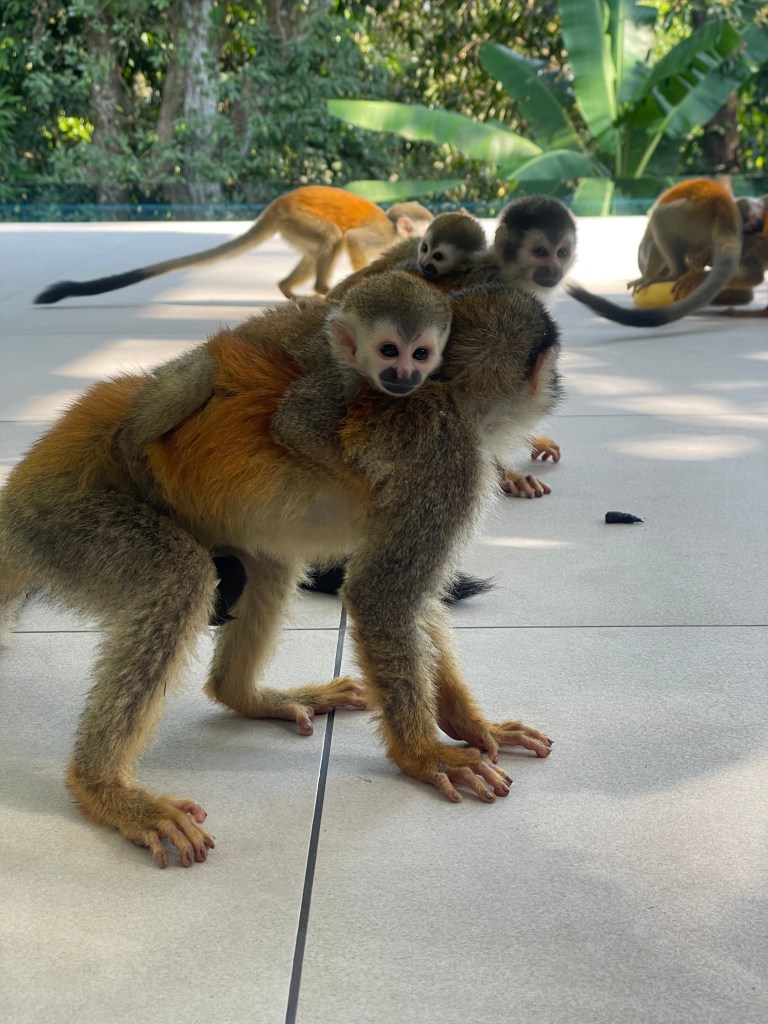
A baby and mommy Titi monkey on my back porch.
There is so much more wildlife that adds to Costa Rica’s unique identity. In Manuel Antonio and along the coast, you can spot dolphins, Mahi Mahi, Sailfish, sea turtles, and many more fish and coral. Iguanas are everywhere, blending into the trees or running across paths, and tiny red-eyed tree frogs always appear in the rainy season. One of my favorite reptiles to spot is a basilisk lizard, also called Jesus Christ lizards because they are known for walking on water. I love spotting these run across the pool. You’ll sometimes see small mammals called coatis scavenging near the forest floor or even see anteaters and raccoons at night. Even crocodiles can be found in the rivers that run through Quepos. The mix of land and marine life shows how alive Costa Rica really is and how connected the people are to nature. Like much of Latin America, the country’s culture and daily life are built around this relationship with the environment—but to me Costa Rica stands out for how much it protects and celebrates it.
On the water, there are strict catch-and-release rules for billfish like sailfish (the exact species in my photo). Charters out of Marina Pez Vela are required to release them alive and keep them in the water, which protects a huge part of the local economy without emptying the ocean. It’s a good example of “enjoy it, don’t erase it.”
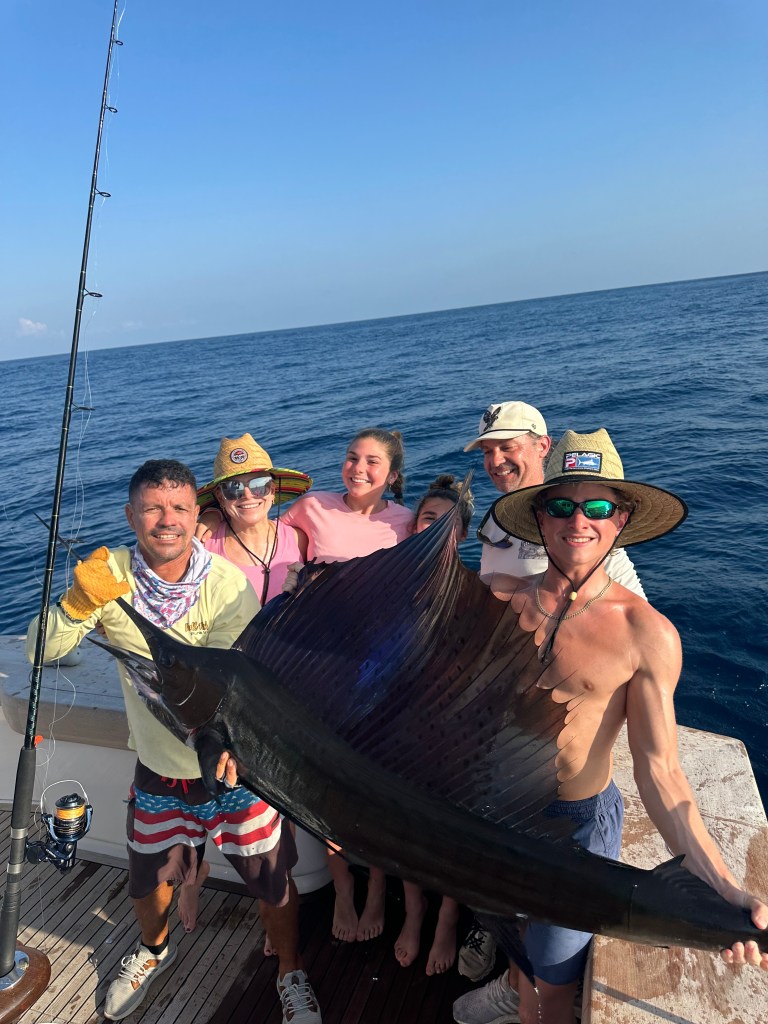
Me and my family with a sailfish we caught.
Being in Manuel Antonio makes you realize how much the environment shapes the beautiful life they have here. The beaches and rainforest aren’t just beautiful, they’re the heart of the region’s identity. In Costa Rica the land is protected, everything connects back to nature. Spending time surrounded by such rich wildlife has made me more aware of how fragile and precious these ecosystems are. It’s not just about seeing cool animals—it’s about understanding how deeply tied Costa Rica’s people, culture, and future are to the land itself.
When I say the land is protected, I mean there are real limits and rules on the ground. Manuel Antonio National Park caps daily visitors and requires advance online tickets to reduce crowding and stress on animals. Bags are checked and single-use plastics and certain snacks aren’t allowed because they attract wildlife and trash the trails. Rangers actually turn people away when tickets are sold out, and tour operators remind you about no-feeding and distance rules. Outside the park, locals and volunteers step in too. In Quepos and Manuel Antonio, “Kids Saving the Rainforest” puts up “monkey bridges”, simple rope crossings, that keep animals from using power lines or running across busy roads. Their rescue center treats injured monkeys, sloths, coatis, and birds, and they’ve documented dozens of species using those bridges. It sounds small, but you literally see them over the streets, and they work.
Monkeys using ropes instead of power lines to travel above streets.
how cute!

The national government backs these beliefs up. Since the late 1990s Costa Rica’s Payment for Environmental Services (PES) program has paid landowners to keep or restore forest, financed partly by fuel taxes and international funds, which helped forest cover rebound and keeps private lands functioning as wildlife corridors. On the coast, the Ecological Blue Flag program rewards communities that keep beaches clean and safe through water-quality testing, waste management, and education campaigns. The land is protected by rangers, community groups, and the state and against from over-tourism, litter, habitat loss.
Works Cited:
“About the Ecological Blue Flag Program.” Instituto Costarricense de Turismo (ICT), 2024, www.ict.go.cr/es/servicios/programa-bandera-azul.html. Accessed 27 Oct. 2025.
“Billfish Conservation in Costa Rica.” Marina Pez Vela, 2024, marinapezvela.com/billfish-conservation-costa-rica/. Accessed 27 Oct. 2025.
“Costa Rica Payment for Environmental Services Program (PES).” National Forestry Financing Fund (FONAFIFO), 2024, fonafifo.go.cr/en/pagos-por-servicios-ambientales/. Accessed 27 Oct. 2025.
“Kids Saving the Rainforest.” Kids Saving the Rainforest, http://www.kidssavingtherainforest.org/. Accessed 27 Oct. 2025.
“Manuel Antonio National Park Regulations.” Sistema Nacional de Áreas de Conservación (SINAC), 2024, http://www.sinac.go.cr/EN-US/ac/acopac/pnam/Pages/default.aspx. Accessed 27 Oct. 2025.
 <em>Traveling Through Manuel Antonio: My Costa Rica Experience"</em><br><br><br>