When I think about Costa Rica, the first thing that comes to mind is the magical and blissful feeling of pura vida. It’s more than something people say, it’s a way of moving through the world that you can actually feel when you’re there. Every time I’m in Quepos, I notice how life seems to slow down. People there take time to care about each other and take time to talk to one another. The days revolve around the ocean, the forest, and being present with one another. This isn’t accidental. Costa Rica is known for prioritizing peace and nature, even famously abolishing its army in 1948 to invest more in education, health, and environmental protection. Nearly a quarter of the country’s land is protected as national parks or reserves, which is one of the highest percentages in the world. Because of this, nature isn’t separate from everyday life, it shapes it. The identity of Costa Rica is rooted in living alongside the land, respecting it, and finding joy in simplicity. Being here has allowed me to see how a place can shape the rhythm of life itself, and how culture isn’t just something you learn about but rather it’s something you feel around you. I feel the peace and tranquility of Costa Rican life everywhere. I feel it in the air and in the pace of the day. I see it in the way people greet you with a smile and when they tell you “pura vida,” they truly mean it.
The phrase pura vida has its own story too. It didn’t actually originate in Costa Rica. The earliest known use comes from a 1956 Mexican film titled Pura Vida, where the phrase was used to describe a character who stayed positive even when things went wrong. The movie played in Costa Rica in the late 1950s, and locals slowly began picking up the expression. By the 1970s and 80s, it became a common everyday saying, and over time it grew into something much bigger than a phrase, becoming a reflection of national identity. What makes it special in Costa Rica is how it shifted from meaning just “pure life” to expressing a whole worldview of being content and happy with what you have, finding joy in simple moments, and staying grounded in the present. When people say pura vida, they’re not only greeting you, but they’re also sharing a cultural value that has formed over generations of living closely with the land, the climate, and each other. Learning how the phrase traveled and transformed makes me appreciate it even more when I hear it in town. It feels genuine and deeply tied to the everyday rhythm of life there.
Pura Vida (1956)

Because pura vida is more than just a phrase, it genuinely shapes the way of life for locals in Costa Rica. You can see it in the slower pace of the mornings, where people take time to drink coffee outside and talk with neighbors instead of the usual morning rush we are used to at home. You see it in the way meals are shared, how people will pause what they’re doing to have a conversation, and how the outdoors is part of everyday living. Stress still exists there, of course, but it doesn’t seem to control people the same way it often does in other places. There’s a real sense of choosing to enjoy each day rather than push through it. Spending time growing up in Costa Rica I had to become used to this. In my younger years I would often stress very much if my family was late for something in Costa Rica but my dad would always reassure me that it didn’t matter! He would tell me “pura vida” and that my life wouldn’t end if I was a few minutes late to one thing. He would tell me the other person would probably be late too and sure enough, they always were. But in Costa Rica this isn’t rude or inconsiderate, it is just a more chill way of life! As a child who used to stress a lot this phrase really shaped me into the happy and confident young woman that I am today, learning that materialistic things are not important.
Being surrounded by nature makes that easier too—the ocean, the mountains, the animals, and the sun encourage a lifestyle that moves with the environment, not against it. Pura vida becomes a reminder to slow down, to breathe, and to appreciate where you are and who you are with. And the more time I spend in Costa Rica, the more I start to understand that this mindset isn’t something performed for tourists, it’s something lived.
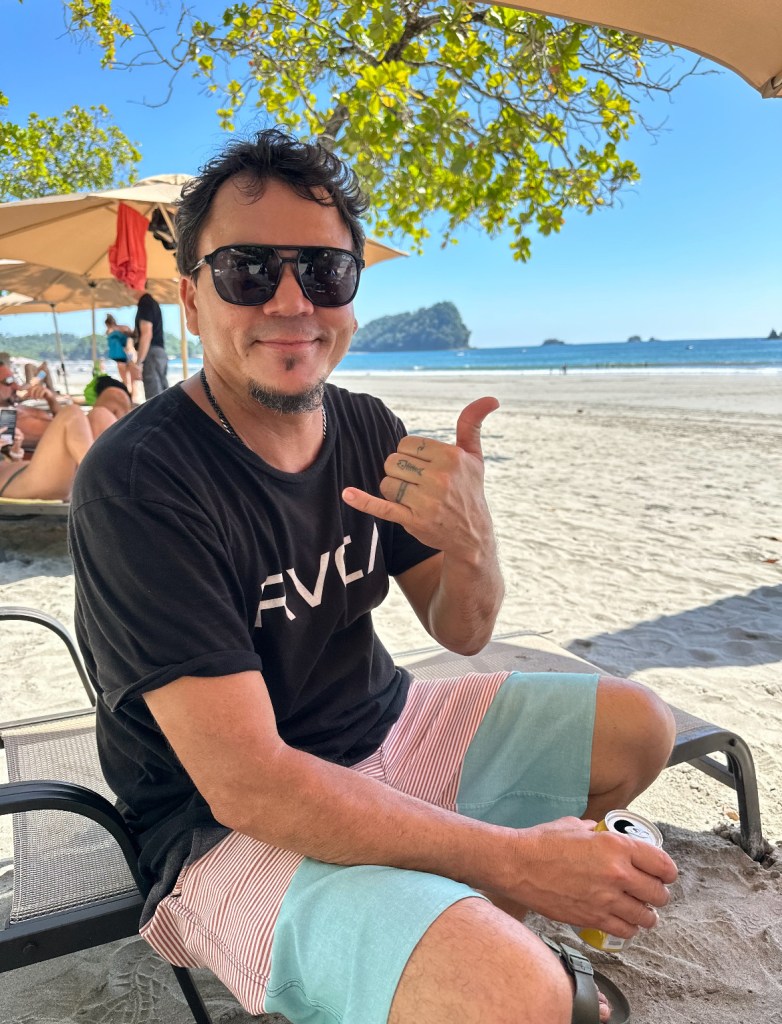
Spending time around the surfers in Manuel Antonio has shown me pura vida in a really real way. They’re the ones who seem to most embody the way of life. They wake up with the sunrise, watch the waves, deciding when to surf based on how the ocean feels rather than what the clock says. They talk to each other in an easy, unhurried way, like there’s no need to rush anything. And the shaka sign, the simple thumb-and-pinky wave, shows up constantly to express pura vida. It’s how they say hello, goodbye, thank you, or even just I see you. It’s casual, relaxed, and genuine, just like the vibe they carry. Being around them made me understand that pura vida isn’t just spoken, it’s practiced. It’s in the way they greet strangers, the way they laugh, the way they stay calm even when the waves aren’t perfect. It’s a reminder that life doesn’t have to forced, sometimes it’s about letting things come to you.
My friend frank
He was the first surfer I ever met. No one can embody “Pura Vida” quite like him
Reading about land in Latin America in LAC class made me look at Costa Rica a little differently. The Oxfam piece talks about how, in a lot of places in the region, not everyone has the same access to land and that whoever controls the land usually ends up with the most say and the most opportunities. Costa Rica feels peaceful and laid-back when I’m there, but that doesn’t mean the question of land doesn’t matter there too. When I’m in Manuel Antonio, I notice how connected people are to the place they live. Fishermen know the ocean like it’s a person. Families run little fruit stands along the road because the food is grown right there. People walk the same beach every day, and it never seems to get old.
What stands out to me is that a lot of this is possible because so much of the land is protected. The forests, the beaches, the national parks, those didn’t just happen. Someone had to decide that the land was worth keeping safe and shared. When I learned that, pura vida started to feel different to me. It’s not just a phrase people throw around. It comes from actually being able to live with the land instead of being pushed away from it. The slower pace, the calm feeling, the way people seem present with each other, it makes sense when the place you live in still feels like home and not something taken or fenced off. It made me realize that pura vida is really about being rooted somewhere, and caring for that place in return.
What I’ve also come to understand is that the calmness of pura vida doesn’t mean people aren’t working, it just means the work looks different than what I’m used to at home. Most people in Manuel Antonio and Quepos are working-class, and a huge part of the local economy is tied to tourism. Many locals work as surf instructors, guides in the national park, cooks in small restaurants, or run family businesses that depend on visitors. Farming also plays a role, but it’s usually small-scale and community based. A lot of the fruit stands I see aren’t selling imported produce, but they’re selling things grown by local families or nearby farmers who depend on the land for their livelihood. That connection to the land didn’t happen randomly either. Costa Rica made the choice decades ago to protect its environment, under leaders like José Figueres Ferrer, who abolished the military in 1948 and redirected funding toward education, conservation, and public land. Later decisions by the National Park Service in the 1970s helped set aside huge areas of rainforest and coastline so they would stay public and shared. When I learned that, it made the whole idea of pura vida feel even more real to me. It’s a lifestyle that isn’t only just cultural, but supported by national policy and by people who believed the land should belong to everyone.
Spending time in Manuel Antonio and Quepos has helped me understand Costa Rica in a more genuine way. The culture, the pace of life, and the connection people have to the land all work together to create the meaning behind pura vida. It’s not something people say just for show, it comes from how they live every day. Learning about land rights and identity in LAC class helped me see that this relationship with the land is intentional and something that has been protected over time. Being in Costa Rica has made me more aware of how the environment shapes culture and how people shape the environment in return. It’s a place that continues to influence how I think about community, nature, and what it means to live simply and fully.
Works Cited:
“Land Rights in Latin America and the Caribbean.” Oxfam International,
https://indepth.oxfam.org.uk/land-rights/where-we-work/lac/. Accessed 5 Nov. 2025.
“Costa Rica’s Army Abolished.” Government of Costa Rica – Official Site,
https://www.presidencia.go.cr/en/history/costa-rica-abolished-its-army/. Accessed 5 Nov. 2025.
“Protected Areas of Costa Rica.” National System of Conservation Areas (SINAC), Ministry of Environment and Energy,
https://www.sinac.go.cr/EN/protected_areas/. Accessed 5 Nov. 2025.
 <em>Traveling Through Manuel Antonio: My Costa Rica Experience"</em><br><br><br>